
Engineered Precision: Flagship Optical & Sun Form Factors
Source high-margin crystal-clear, ergonomic, and lifestyle frames calibrated for medical-grade ophthalmic glazing and all-day visual ergonomics.

The Material Science Behind Crystal-Clear Optical Formulations
Overcoming plasticizer evaporation, thermal deformation, and UV-mediated oxidative photolysis in translucent eyewear engineering.
In wholesale optical distribution, the category of "clear frames" presents unique manufacturing hurdles rarely encountered in pigmented or opaque tortoiseshell production. When clear eyeglass frames are displayed on practice dispensing boards, any raw material contaminant, internal air entrapment, mold shrinkage flow line, or hinge-core porosity is instantly visible to both the dispensing optician and the end patient. As an industry-leading optical frames manufacturer, our production matrix resolves these quality pain points through closed-loop polymer filtration and advanced injection molding techniques.
Modern clear eyewear relies heavily on two divergent chemical paths: high-molecular-weight cellulose acetate and medical-grade transparent polyamides (TR-90 / Grilamid). While commodity injection-molded acrylics or recycled polycarbonates often degrade within three to six months—manifesting unsightly yellow discoloration (UV-yellowing delta shift) and stress-cracking around lens bevels—our manufacturing protocol incorporates specialized UV-stabilizer inhibitors (Benzotriazole absorbers) combined with plasticizer-migration barriers. This ensures that clear crystal frames maintain optical transparency exceeding 92% transmission while withstanding high-index lens insertion under continuous circumferential tension.
| Material Property | Cellulose Acetate (Bio-Clear) | Ultra-Clear TR90 Polyamide | Standard Commercial PC |
|---|---|---|---|
| Luminous Transmittance | 91.8% – 93.2% | 90.5% – 92.0% | 86.0% – 88.5% |
| Lens Insertion Stability (Cold/Warm) | Warm bevel insertion (60°C); cold set | Cold snap-fit glazing | Prone to stress cracking at groove |
| Accelerated UV Yellowing (1000h Xenon) | ΔE ≤ 1.2 (Imperceptible) | ΔE ≤ 1.5 (Stable) | ΔE ≥ 4.8 (Visible degradation) |
| Skin Sebum & Sweat Corrosion Resistance | Excellent; polishable surface renewal | High chemical inertness | Surface clouding over extended wear |
Future Sourcing & Procurement Trends in Clear Eyewear (2025–2030)
Critical market shifts reshaping supply chain strategies for optometry practices, D2C disruptors, and clinical buying groups.
1. Bio-Degradable & Recycled Crystal Acetate
Global environmental mandates (EU Green Deal and ESG enterprise criteria) are driving mass replacement of phthalate plasticizers with bio-based triethyl citrate (TEC). Modern buyers now mandate ISO 14855 compostability verification for translucent frames without sacrificing flexural modulus or clarity.
2. Translucent Tint Gradients & Champagne Undertones
Clinical eyewear consumers increasingly reject stark "lab-safety-glass" clear finishes in favor of calibrated crystal variants: subtle champagne, iced tea, pale smoke, and anti-reflective peach undertones that complement a broader spectrum of patient Fitzpatrick skin phototypes.
3. Hybrid Structural Micro-Co-Molding
The convergence of clear rims with embedded, feather-light Japanese titanium core-wires and micro-welded five-barrel hinges. This eliminates temple spread and frame slippage, permitting high-cylinder prescription lenses to sit perfectly within the pantoscopic tilt angle.
Engineered Heritage: 75+ Years of Optical Excellence
Combining heritage US frame curation with advanced Chinese precision manufacturing, tooling, and rapid distribution.
Medical-Grade Quality Control
Every batch undergo rigorous hinge torque testing (tested through 20,000 continuous opening cycles), ultrasonic solvent cleansing to eradicate internal mold oil traces, and optical bench testing to verify zero structural birefringence along the lens bevel apex.
Comprehensive Segment Tooling
With an active tooling inventory supporting 447+ frame silhouettes across 19 dedicated lines (including Wide Guyz extended fit, armouRx protective, K Flex resilient, and pediatric collections), our factory delivers ready-to-dispense solutions tailored for broad demographics.
Turnkey OEM/ODM & Supply Agility
Backed by our distribution infrastructure in St. Cloud, Minnesota, and direct tier-1 manufacturing plants in China, we offer low-risk sample validation, custom CAD/CNC mold customization in 14 business days, and end-to-end container logistics worldwide.
Frequently Asked Questions by Ophthalmic Frame Buyers
Clear, direct answers regarding material certifications, lens glazing parameters, private label MOQs, and anti-yellowing warranties.
Q: How do you prevent clear acetate and TR90 frames from turning yellow?
We source raw optical pellets exclusively from certified petrochemical producers (such as EMS-Grivory and Mazzucchelli) compound-mixed with proprietary UV-absorber packages. Each batch undergoes 1,000-hour accelerated Xenon Arc weathering chamber exposure to confirm delta color variations do not exceed optical tolerances (ΔE < 1.5).
Q: Can our optical lab cold-glaze high-index prescription lenses into your clear frames?
Yes. Our TR90 clear frames are engineered with memory flexure thresholds that allow cold snap-fit insertion without perimeter whitening or micro-fissuring. For our clear cellulose acetate lines, standard hot-air frame warmers (55°C – 65°C) ensure optimal groove expansion and clean contraction around high minus and plus power curves.
Q: What are the Minimum Order Quantities (MOQ) for custom OEM clear frame orders?
For ready-stock frame models from our 447+ style catalog, MOQ begins at 50–100 pieces per colorway for certified retail practices. For customized bespoke CAD/CAM injection tooling or specialized private label laser branding, production runs typically begin at 300 to 500 units per colorway.
Q: Are your clear eyeglass frames compliant with US FDA, CE, and ISO standards?
All ophthalmic and sunglass frames leaving our manufacturing lines comply fully with ISO 12870 (Ophthalmic Optics - Spectacle Frames), ANSI Z80.3, FDA drop-ball impact resistance requirements (21 CFR 801.410), and REACH SVHC chemical safety guidelines for direct cutaneous contact.
Q: How do your clear frames prevent visible temple core-wire oxidation?
We treat all internal German and Japanese wire cores with an electrolytic micro-nickel-free passivation or galvanic gold plating prior to injection or lamination. This prevents moisture, perspiration, or adhesive chemicals from creating green copper-oxide blooms inside the clear temples.
Q: Do you provide sample assortments for clinic board trial evaluations?
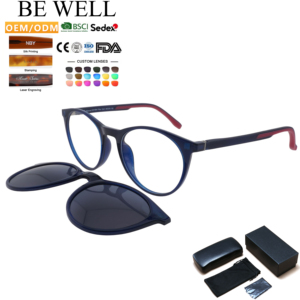
We welcome qualified independent optometry practices, clinical hospital groups, and distributors to request a curated verification sample kit containing representative models across our 19 core collections, including clear styles, titanium hybrids, and polarized clip-on assemblies.
Transform Your Eyewear Board with Factory-Direct Clear Frames
Partner with a dependable manufacturer backed by 75+ years of optical precision. Inquire today to request complete wholesale catalogs, factory pricing sheets, and custom tooling consultation.