
Cat-eye optical frames remain popular because their lifted corners add definition without making every design feel alike. For eyewear brands, retailers, and sourcing teams, the challenge is finding manufacturers that can deliver consistent quality, comfortable fit, and dependable production. A striking frame is not enough. Hinge alignment, smooth acetate edges, balanced weight, and secure lens grooves matter during daily wear.
This guide introduces ten Chinese manufacturers serving the cat-eye optical frame market. It considers product range, material options, customization, stated quality-control practices, and the clarity of each company’s available information. The list is a starting point, not a guarantee of performance or a universal ranking. A supplier’s website is only a starting point.
Before choosing a partner, request current specifications, production timelines, sample terms, and details about inspection procedures. Check how the frame feels on different face shapes, and inspect the finish under ordinary indoor light. Ask whether color, sizing, logos, and packaging can be adjusted for your order. Small details reveal a lot. Public information may not confirm every factory capability, and some claims require direct verification. Treat that uncertainty seriously. Compare samples and written quotations before making a commitment. This overview is designed to help readers ask sharper questions and identify manufacturers worth evaluating further.
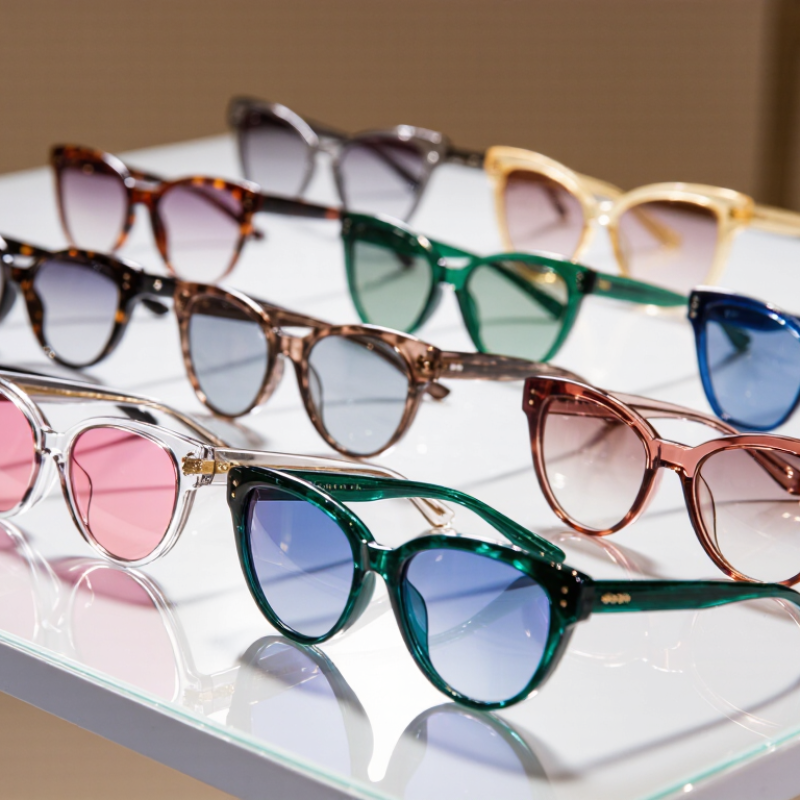
What Defines Cat-Eye Optical Frames?
Cat-eye optical frames are defined by an upswept outer edge, usually created by raised endpieces and a tapered brow line. The silhouette draws attention toward the temples, while the lower rim may be rounded, softened, or angular. These details matter: a dramatic lift can feel striking, but it may crowd a narrow face or sit awkwardly beneath the brow. There is no reliable face-shape formula. Fit is personal.
For prescription wear, shape alone is not enough. Frame width, bridge fit, lens height, and pupil position affect comfort and usable vision. The World Health Organization’s 2019 World Report on Vision estimated that at least 2.2 billion people have near or distance vision impairment; at least 1 billion cases could have been prevented or remain unaddressed. That scale makes precise optical fitting more than a style detail. ISO 12870:2016 also sets requirements and test methods for spectacle frames, including durability and construction—not a universal cat-eye shape.
Tips: Check that the frame stays level when you smile. Ask an optician to verify lens centration and bridge fit. A bold upsweep looks good in photos, sometimes less so after eight hours.
| No. | Evaluation Dimension | What Defines a Cat-Eye Optical Frame | Practical Manufacturer Check |
|---|---|---|---|
| 1 | Outer-corner lift | The frame’s outer corners rise above the inner corners, creating the characteristic upswept outline. | Review front-view samples and confirm that the corner height and curve match the approved drawing. |
| 2 | Browline shape | The upper rim commonly sweeps upward toward the temples; its angle and depth strongly influence the style. | Check symmetry between left and right rims and compare the browline with the design specification. |
| 3 | Lens shape and usable area | Cat-eye lenses may be rounded, angular, or softly tapered, while the overall frame retains an upswept silhouette. | Confirm lens dimensions and shape against the optical drawing; check that the intended prescription lens can be fitted. |
| 4 | Frame material | Common optical-frame materials include cellulose acetate, injection-molded plastics, and metals; each has different construction and finishing characteristics. | Request material specifications and samples, then assess surface finish, consistency, and suitability for the design. |
| 5 | Bridge fit and dimensions | The bridge connects the rims and affects how the frame sits on the nose; fit depends on its shape and the wearer’s facial features. | Verify bridge measurements and test fit samples on the intended sizing range before approving production. |
| 6 | Temple design and length | Temples extend from the hinges to the ears and contribute to frame stability and wearing comfort. | Check temple length, alignment, opening and closing action, and fit behind the ears. |
| 7 | Hinges and assembly | Hinges join the temples to the front and must operate smoothly while holding the frame securely. | Inspect hinge attachment, screw security, frame alignment, and repeated opening and closing on sample units. |
| 8 | Surface and edge finishing | Polished surfaces and smooth edges affect the frame’s appearance and the comfort of contact points. | Inspect for rough edges, visible scratches, uneven coloring, and inconsistent polishing under good lighting. |
| 9 | Size and fit consistency | Frame width, lens width, bridge width, and temple length are commonly stated in millimeters and help describe fit. | Compare production samples with the agreed measurement tolerances and check left-right symmetry. |
| 10 | Quality and compliance documentation | Optical frames intended for a particular market may need to meet that market’s applicable product and labeling requirements. | Identify the destination-market requirements and request relevant test reports, material records, and inspection documentation. |
Note: This table lists practical evaluation criteria, not a ranked list of manufacturers.
FAQS
Its outer edges rise toward the temples, often with a tapered brow line. Lower rims can be rounded or angular. The lift stands out.
There is no dependable face-shape formula. Check whether the frame sits level when you smile. Try it on for a while, not just in a mirror.
Frame width, bridge fit, lens height, and pupil position all matter. Ask an optician to check alignment. Shape alone is not enough.
Look for smooth edges, even finishes, secure hinges, and straight-set lenses. Open and close the temples repeatedly. One sample proves little.
Get written specifications for materials, colors, nose pads, logo placement, and measurement tolerances. Vague promises are hard to check later.
Compare approved samples with frames from multiple batches. Check dimensions and finish across units. This takes extra effort, but one attractive sample can mislead.
Request details about labeling, packaging, carton sizes, and product documents. Confirm destination requirements independently. Paperwork can be tedious.
Compare total landed cost, not just the frame price. Smaller orders may mean fewer color choices or higher unit costs. It is easy to overlook.
Conclusion
Cat-eye optical frames combine practical vision correction with a distinctive upswept silhouette, shaped by choices in proportion, materials, fit, and finishing. China’s optical frame industry supports a wide range of cat-eye styles through coordinated design, component production, assembly, and quality checks. Understanding these processes helps buyers assess whether a manufacturer can deliver consistent construction as well as the desired look and comfort.
This overview explains how to evaluate leading manufacturers by examining production capabilities, material options, workmanship, customization services, communication, and export readiness. It also introduces ten manufacturers in China and outlines ways to compare them for quality, design flexibility, production capacity, and reliability. These considerations can help buyers identify a suitable manufacturing partner and make more informed sourcing decisions.